
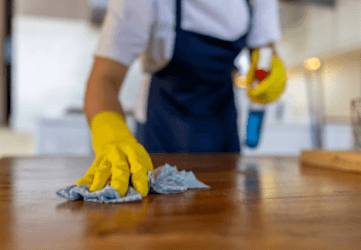
 *Photo: Unsplash*
Montreal decks take more punishment than almost any other outdoor surface in Canada. From November to April — five full months — your cedar or composite deck is buried under ice and snow, exposed to temperatures that swing between −25 °C and +5 °C on a single January day. When spring finally arrives, that freeze-thaw cycling has left behind grey, cracked wood, green algae colonies, cottonwood fluff packed into every board groove, and white mineral haze from calcium-heavy melt water. Knowing how to clean a deck correctly — matched to your specific deck material — is what separates a deck that lasts 25 years from one that needs replacing in 10.
This guide covers every deck surface common in Montreal homes: cedar (the most widely used wood in Quebec), pressure-treated pine (standard for contractor builds in Laval, Brossard, Longueuil, and DDO), composite decking (Trex, TimberTech, Fiberon — increasingly popular in new-build condos and renovated triplexes), and hardwood exotics (IPE/mahogany in Westmount, Outremont, and TMR premium builds). Each requires a completely different cleaning approach — what works on composite can permanently damage cedar, and what removes green algae from pressure-treated pine will bleach composite to a chalky white.
Montreal-Specific Deck Challenges
Generic deck-cleaning guides skip the challenges that are particular to Montreal's climate and housing stock:
- Cottonwood (peuplier du Canada) season, mid-May to mid-June — white fibrous fluff from eastern cottonwood and trembling aspen trees blows across all Montreal boroughs and packs densely into deck board gaps and surface grooves. Apply water or soap before sweeping and you create a sticky paste that is nearly impossible to remove.
- Spring green and black algae: Montreal decks sit under ice and snow with zero UV exposure for 5–6 months. Shaded or north-facing decks develop thick colonies of Cladosporium (black) and Chlorophyta (green algae) that will not respond to dish soap — oxygen bleach or an algaecide is required.
- Hard water (90–150 mg/L calcium) from the St. Lawrence watershed leaves a white calcium haze on composite boards and pressure-treated wood after hose washing. A final white vinegar rinse dissolves the calcium carbonate before it crystallizes.
- Freeze-thaw wood damage: The 55 °C swing between Montreal's summer peak (+30 °C) and winter minimum (−25 °C) expands and contracts wood fibres repeatedly. Unsealed cedar and pressure-treated pine grey and crack faster here than in any other major Canadian city.
- Pre-war triplex galeries (the iconic wooden wraparound back galleries of Plateau, Rosemont, HoMa, NDG, Villeray, and Hochelaga-Maisonneuve): these are typically Douglas fir or hemlock, often painted, and require a completely different protocol from modern cedar or composite builds.
Supplies You'll Need
| Item | Price | Montreal retailer | |---|---|---| | Push broom or stiff deck brush | $12–25 | Canadian Tire / Home Depot | | OxiClean Outdoor Cleaner (oxygen bleach) | $13–18 / 1.13 kg | Canadian Tire / Home Depot | | TSP-PF (heavy mold/algae) | $8–14 / 900 g | Canadian Tire / Rona | | Oxalic acid deck brightener | $16–22 / 500 mL | Home Depot / Rona | | Dawn or Palmolive dish soap | $3–5 | IGA / Maxi / Metro | | White distilled vinegar (5% acetic acid) | $2.50–5 / 1.89 L | IGA / Maxi / Metro | | Composite deck cleaner (e.g., Trex Cleaner) | $10–16 / 500 mL | Home Depot | | Nitrile gloves | $8–12 / pack | Jean Coutu / Canadian Tire | | Safety goggles | $5–10 | Canadian Tire | | Garden hose with adjustable nozzle | owned | — | | Pressure washer (if needed) | $50–75 / day rental | Home Depot / Rona |
Do not use bleach (sodium hypochlorite) on cedar — it destroys the wood's natural tannins, accelerates grey oxidation, and leaves a bleached, chalky surface that never takes stain evenly.
Step 1: The Cottonwood Sweep — Always First (Montreal-Specific)
If you are cleaning your deck any time from late May through July, the most important step is one that no generic guide mentions: dry-sweep before any water or soap contact.
Cottonwood fluff from peuplier du Canada (eastern cottonwood) is released across all Montreal boroughs starting in mid-May and lasting 3–4 weeks. The white fibres settle into every deck board gap, knot, and surface groove. Once wet, they mat into a dense, soap-resistant paste.
Protocol: 1. Use a stiff-bristle push broom and sweep the entire deck surface with firm strokes along the board grain 2. Pay particular attention to the gaps between boards — run a stiff-bristle brush along each gap to dislodge packed fluff 3. Sweep the accumulated debris off the deck and into the yard or a garbage bag 4. Only after all dry debris is removed should you apply water or any cleaning solution
This step also removes general dirt, sand, cottonwood, pollen, and bird droppings that would otherwise muddy your cleaning water and reduce the effectiveness of any cleaner.
Step 2: Identify Your Deck Material
Before reaching for any cleaner, identify what your deck is made of. Using the wrong product is the most common and most expensive deck-cleaning mistake:
| Material | How to identify | DO NOT use | |---|---|---| | Cedar | Reddish-brown when new; weathers to grey; light, aromatic smell; common in Quebec | Bleach, vinegar, Murphy's Oil Soap, pressure washer >1,200 PSI | | Pressure-treated pine | Greenish-grey tint; visible preservative grain; denser/heavier than cedar | Vinegar on fresh PT (acid can leach copper-based preservative) | | Composite (Trex/TimberTech) | Uniform texture; no grain variation; hollow or solid profile; often cap-stock coated | TSP, bleach, abrasive scrubbers, pressure washer >1,200 PSI | | Hardwood (IPE/mahogany) | Very dense; sinks in water test; chocolate-brown; used in Westmount/Outremont premium builds | Bleach, harsh acids, power washing >1,000 PSI | | Painted galerie (triplex) | Old paint layers visible; fir or hemlock grain under paint; common Plateau/Rosemont | Paint stripper without testing; harsh acids |
Step 3: Cleaning by Deck Material
Cedar Decks
Cedar is Quebec's most popular deck wood because it resists moisture and insects naturally. But it requires a gentle touch:
For regular annual cleaning: 1. Pre-wet the deck surface with a garden hose 2. Mix 120 mL of OxiClean Outdoor Cleaner per 4 L of warm water in a bucket 3. Apply with a stiff deck brush and scrub along the board grain (never cross-grain — this raises wood fibres) 4. Let the solution sit for 10–15 minutes 5. Rinse thoroughly with a garden hose; work from the house outward 6. Apply a 1:10 white vinegar-to-water rinse to remove any hard water calcium deposits from the St. Lawrence watershed 7. Let the deck dry completely (2–3 sunny days minimum before applying any stain or sealer)
For heavy mold or grey oxidation: Cedar turns grey when its natural tannins oxidize in UV light. To restore the warm reddish-brown colour before re-staining: 1. Apply oxalic acid deck brightener (Home Depot, ~$18/500 mL) full-strength to the grey areas 2. Let sit 15–20 minutes 3. Scrub gently with a soft brush (oxalic acid is mild but acidic — wear gloves and goggles) 4. Rinse thoroughly
The oxalic acid chelates the oxidized iron and tannin compounds that cause grey colouration. Most cedar will return to within 70–80% of its original colour after one treatment.
Pressure washing cedar: Maximum 1,200 PSI with a 40° fan tip held at least 30 cm from the surface. Never use a 0° concentrated tip on cedar — it gouges the wood. Do not pressure wash against the grain.
Pressure-Treated Pine Decks
Pressure-treated pine (PT) is the standard contractor deck choice in suburban Montreal — Laval, Brossard, Longueuil, DDO, Kirkland, Pierrefonds.
1. Pre-wet the surface 2. Mix OxiClean Outdoor or TSP-PF (trisodium phosphate, phosphate-free) at the label rate 3. Scrub with a stiff push broom, working along the board grain 4. For heavy green algae: TSP-PF at full label strength, 15-minute dwell time 5. Rinse well — a pressure washer at 1,200–1,500 PSI is fine for PT (maximum 2,000 PSI for severe staining only) 6. Apply the white vinegar hard water rinse
Do not use vinegar as your primary cleaner on fresh PT decking — the acid can interact with copper-based preservative (ACQ or MCQ) in decks less than 2 years old. Use oxygen bleach instead.
Composite Decks (Trex, TimberTech, Fiberon)
Cap-stock composite decks are designed for low maintenance, but they are not maintenance-free and are sensitive to abrasion:
1. Rinse the surface with water 2. Apply a composite-specific cleaner (Trex Cleaner, TimberTech Deck Wash, or OxiClean Outdoor diluted to ¼ strength) 3. Scrub gently with a soft-bristle brush only — never steel wool, scouring pads, or stiff wire brushes 4. For stubborn organic staining (bird droppings, grease, mold): let the OxiClean solution dwell 15 minutes before scrubbing 5. Rinse completely — any residue left to dry creates a white streaking problem 6. Apply a 1:10 white vinegar rinse to address the hard water white haze that appears on Montreal composite decks after hose washing. The vinegar dissolves calcium carbonate before it dries to a permanent deposit.
Pressure washing composite: Maximum 1,200 PSI, 40° tip, minimum 30 cm distance. Never use a 0° tip on composite — it blasts off the cap-stock finish and voids manufacturer warranties.
Hardwood (IPE / Mahogany)
Exotic hardwood decks in premium Montreal neighbourhoods (Westmount, Outremont, TMR, Golden Square Mile) are extremely dense and durable but require oil-based maintenance:
1. Sweep and pre-rinse 2. Use a mild dish soap solution (30 mL Dawn per 4 L water) and a soft brush 3. Rinse well 4. For algae: diluted OxiClean at ¼ strength only — exotic hardwoods can discolour with stronger concentrations 5. After cleaning and drying completely (3+ days), apply a hardwood deck oil (Ipe Oil Hardener, Penofin, or Cabot Australian Timber Oil available at Home Depot/Rona ~$45–70)
Painted Galeries (Pre-War Triplexes)
The iconic wooden back galleries of Plateau, Rosemont, HoMa, Villeray, and NDG are typically Douglas fir or hemlock under multiple paint layers:
1. Sweep debris; check for any paint peeling, rot, or structural deterioration 2. Wash with a mild TSP-PF solution (30 mL per 4 L warm water) 3. Scrub with a medium-bristle brush; avoid saturating old paint 4. Rinse gently — high pressure can lift old paint layers 5. Let dry completely before touching up or repainting
Step 4: The Montreal Hard Water Rinse
Montreal's municipal water contains 90–150 mg/L of dissolved calcium from the St. Lawrence River watershed. After any deck wash, if you let tap water dry on the surface, it leaves a white calcium carbonate haze — especially visible on composite and pressure-treated wood.
Prevent hard water deposits: As your final rinse step, spray or brush on a 1:10 solution of white vinegar and water (about 200 mL of vinegar per 2 L of water). This dissolves any calcium before it crystallizes. Rinse off after 2 minutes with fresh water and allow the deck to air dry.
Deck Staining and Sealing: Montreal's Timing Window
Cleaning alone does not protect an uncoated cedar or pressure-treated deck. Applying a penetrating stain or sealer is critical for deck longevity in Montreal's climate.
Montreal's deck staining season: May to September only. Stains and sealers require: - Ambient temperature 10 °C–30 °C at application AND for 24–48 hours afterward - No rain forecast for 24–48 hours - Surface completely dry (a minimum of 48–72 sunny hours after washing)
Montreal's first dependable window opens in mid-May (once nighttime lows are consistently above 10 °C) and closes in late September (when nights dip below 10 °C). This gives you a reliable 4-month staining window — plan your cleaning in early May so the deck is dry and ready to stain by Victoria Day weekend.
Recommended stains for Montreal: - Cedar: Semi-transparent penetrating oil stain — Cabot Australian Timber Oil (Home Depot ~$55/3.78 L) or Olympic Elite (Home Depot ~$50/3.78 L). Avoid film-forming stains on cedar; they peel under Montreal freeze-thaw. - Pressure-treated: Semi-transparent or solid deck stain — Sikkens Cetol DEK Finish (Rona/Home Depot) or Cabot Australian Timber Oil. - Composite: No staining needed for cap-stock composite. Some uncapped composites benefit from a composite-specific sealer; check with the manufacturer.
Condo and Triplex-Specific Rules
DCC Condo Syndicate Rules
If you own a condo with a private deck, balcony, or exclusive-use rooftop terrace in buildings across Griffintown, Square-Victoria, Plateau, Mile End, or NDG, check your Declaration de Copropriété (DCC) before cleaning:
- Many syndicates specify approved stain colours for decks visible from the street or common areas
- Pressure washing restrictions: Water streaming toward neighboring units or common areas can trigger complaints; some DCCs require advance notice before pressure washing
- Greywater drainage: Water with cleaning products must drain to a pervious surface (lawn, garden) not directly into building drains or the storm sewer
TAL Galerie Maintenance (Pre-War Triplexes)
Under Quebec's Civil Code and the Tribunal administratif du logement (TAL) framework:
- Structural maintenance of the galerie (frame, joists, railings for safety) = landlord's responsibility under Art. 1854
- Regular cleaning of the galerie surface = tenant's responsibility under Art. 1911
- If your galerie boards have significant rot, bouncing boards, missing railings, or deteriorated structural posts, document with photos and notify your landlord in writing
Seasonal Cleaning Calendar for Montreal Decks
| Season | Task | |---|---| | Late April / early May | Inspect for winter damage; replace rotted boards before cleaning | | Mid-May (post-cottonwood dry sweep first) | Full deck wash; let dry 3+ days | | Late May–early June | Apply stain or sealer in dry weather window | | Mid-June | Post-cottonwood season check-up; clear any late debris from board gaps | | July–August | Monthly sweep; rinse grease/bird droppings promptly | | October | Last sweep before snow; remove furniture; apply end-of-season penetrating oil to cedar if skipped in spring |
FAQ
Q: How do I get rid of green algae on my Montreal deck?
A: Green algae on Montreal decks is caused by 5–6 months of low UV under snow cover. OxiClean Outdoor Cleaner (Canadian Tire / Home Depot, ~$15/kg) dissolved in warm water is the safest effective treatment for all deck surfaces — cedar, pressure-treated, composite, and hardwood. Apply at the label concentration, let dwell 10–15 minutes, scrub with a stiff brush, rinse well. For black mold (Cladosporium), use TSP-PF at full label strength on cedar and pressure-treated only. Never use sodium hypochlorite bleach on cedar.
Q: Can I use a pressure washer on my cedar deck?
A: Yes, but with strict limits. For cedar: maximum 1,200 PSI, 40° fan tip (never 0°), held at least 30 cm from the surface. Always spray along the board grain — spraying across the grain tears up the wood fibres. Even within these limits, repeated pressure washing shortens the life of cedar by stripping the natural tannin layer. For annual maintenance, a garden hose with a nozzle and a scrub brush is gentler and sufficient.
Q: My deck is grey — can I restore the colour without replacing the boards?
A: Yes, in most cases. Grey cedar is caused by UV oxidation of the wood's natural tannins — the wood is not damaged, just oxidized. Apply oxalic acid deck brightener (Home Depot / Rona, ~$16–22 / 500 mL) to the grey surface, let sit 15–20 minutes, scrub gently, and rinse. Most cedar will restore 70–80% of its original warm reddish-brown. Follow immediately with a penetrating oil stain to lock in the restored colour and slow future graying. Pressure-treated grey pine also responds to oxalic acid brightener.
Q: How often should I clean and stain my Montreal deck?
A: Cedar decks: clean every spring, re-stain with a penetrating oil every 2–3 years (cedar greys faster without UV protection). Pressure-treated pine: clean every spring, re-stain every 2–4 years (PT weathers more slowly than cedar). Composite decks: clean once or twice a year; no staining needed for cap-stock composite. A quick test — pour a teaspoon of water on the deck surface. If it beads up, the sealer is still effective. If it soaks in within 30 seconds, it's time to re-stain.
Q: What's the correct way to clean a Trex or TimberTech composite deck?
A: Never use TSP, bleach, or abrasive scrubbers on composite — they damage the cap-stock surface and void your warranty. Use the manufacturer's recommended cleaner (Trex Cleaner, TimberTech Deck Wash) or OxiClean Outdoor diluted to ¼ strength. Scrub with a soft-bristle brush only. Rinse completely to prevent residue from streaking. For the white haze that appears on Montreal composite decks from hard water (90–150 mg/L calcium), follow up with a 1:10 white vinegar-to-water rinse, let sit 2 minutes, then rinse off.
Q: My triplex back galerie boards are rotting — is that my problem to fix as a tenant?
A: No. Structural decay of the galerie (rotted boards, failing joists, loose railings) is the landlord's responsibility under Art. 1854 of Quebec's Civil Code (the landlord must maintain the property in habitable condition). Document the rot or structural defect with photos and notify your landlord in writing, keeping a copy. If the landlord does not act within a reasonable time (generally 10–30 days depending on severity), you can file a complaint at the Tribunal administratif du logement (TAL). Regular cleaning of a structurally sound galerie surface is the tenant's responsibility — but structural repairs are not.
---
*Need professional cleaning help for your Montreal home, condo, or Airbnb? Sparkling Stays provides [home cleaning](/en/services/home-cleaning), [deep cleaning](/en/services/deep-cleaning), and [move-in/out cleaning](/en/services/move-in-out-cleaning) across Greater Montreal. [Book online](/en/book-now) or call 438-223-2011.*
*Related guides: [How to Clean a Balcony in Montreal](/en/blog/how-to-clean-a-balcony-montreal) · [How to Clean Outdoor Patio Furniture](/en/blog/how-to-clean-outdoor-patio-furniture-montreal) · [How to Clean a Concrete Patio](/en/blog/how-to-clean-a-concrete-patio-montreal) · [How to Clean a BBQ/Grill](/en/blog/how-to-clean-a-bbq-grill-montreal) · [Eco-Friendly Cleaning Montreal](/en/blog/eco-friendly-cleaning-montreal)*

