
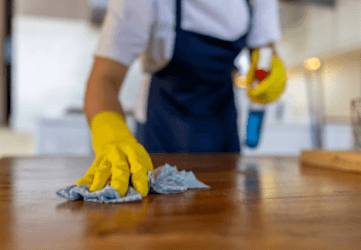
 *Photo: Unsplash*
Montreal's work-from-home culture is among the densest in Canada. The Plateau, Mile-Ex, Rosemont, and Côte-des-Neiges are home to thousands of employees at Ubisoft, Square Enix, CAE, Lightspeed, and hundreds of tech startups operating from pre-war triplexes converted into live-work apartments. When your office is also your home, the kitchen drawer full of rubber bands and expired coupons is never more than five feet from your standing desk.
Montreal's climate complicates the equation. Summer humidity peaks at 70–75% in July and August. Rubber bands left in a junk drawer for a single summer turn sticky and brittle. A drawer left shut all season can open in September revealing traces of mold on forgotten paper receipts — especially if the drawer sits against an exterior wall.
And then there is the dust. Street-facing apartments in NDG, Rosemont, Plateau-Mont-Royal, and Villeray take in significant fine particulate from traffic. Keyboards and screens on desks near open windows accumulate a visible film of city dust within two weeks — faster if you are near a construction site, and in Montreal, there is always a construction site nearby.
---
The July 1 Junk Drawer Purge
If you have lived in Quebec for any length of time, you know that July 1 is Déménagement — Moving Day. Roughly 100,000 households move on or around this date every year. Most of them open their junk drawer, stare at the contents, and either shove everything into a box or throw it all in a garbage bag. The week around July 1 is the ideal time to completely reset your junk drawer and home office. You are already disrupting your space. Take two hours and do it properly.
---
Part 1: Cleaning and Organizing the Junk Drawer
Step 1: Empty Everything
Pull the drawer completely out if possible. Lay a clean towel or sheet of kraft paper on a table or counter. Empty the entire contents onto it. Do not attempt to clean or sort in the drawer itself — you will miss the corners and the debris that has settled to the bottom.
Montreal-specific inventory check:
- TAL (Tribunal administratif du logement) lease renewal notices and maintenance request carbon copies — these should be filed, not left in a junk drawer
- Hydro-Québec paper bill stubs — shred anything older than 12 months
- Déclaration de revenus (Quebec income tax) documents — anything older than 6 years can be shredded per Revenu Québec guidance
- Old Opus cards (STM transit cards) — check if they still have value at a métro station terminal before discarding
- Multiple phone chargers for phones you no longer own
Step 2: Clean the Drawer Interior
Once empty, use a dry microfibre cloth or a soft brush to sweep crumbs and debris out of the corners and toward the center. Then vacuum the drawer with a brush attachment.
Next, dampen a cloth with a solution of warm water and a few drops of Dawn dish soap. Wipe the interior walls, base, and front inner face. For pre-war triplex kitchen drawers with painted wood interiors, use pH-neutral dish soap only — no vinegar, no all-purpose cleaner with ammonia, which can strip or dull older paint.
For melamine or laminate-lined drawers (common in 1980s–1990s Montreal kitchen cabinetry), a diluted white vinegar solution (1:4 ratio with water) is safe. Wipe dry immediately — laminate does not tolerate standing water.
If your drawer is one of the soft-close under-desk drawers common in IKEA KALLAX or ALEX desk setups popular in Montreal apartments, use a barely-damp cloth and a dry toothbrush for the drawer slide track.
Montreal summer humidity note: After cleaning, allow the drawer to air dry completely — at least 30 minutes — before replacing any liner. Trapping moisture under a drawer liner in July or August creates ideal conditions for mold and paper decay. In high-humidity months, consider a silica gel desiccant packet at the back of the drawer. Silica gel packets are available at IGA, Maxi, Canadian Tire, and most kitchen stores.
Step 3: Sort and Return
Before returning anything to the drawer, apply a simple rule: if you have not needed this item in the past 12 months and cannot name a specific upcoming use, it goes.
Organize what remains into small categories:
- Batteries — group by size (AA, AAA, 9V). Test with a battery tester or a basic LED flashlight before keeping
- Writing tools — test each pen. Montreal winter cold causes gel pens to stop working even indoors if stored near an exterior wall
- Hardware — small screws, picture hooks, wall anchors. Keep these in a small zip-lock bag to prevent the single screw that migrates to every corner of every drawer in every home in Canada
- Cables and adapters — one round of "do I know what this connects to?" is sufficient. If you cannot identify the device, the cable is not worth keeping
- Medications — check expiry dates. Dispose of expired medications at any Jean Coutu, Pharmaprix, or Brunet pharmacy — do not put them in household recycling or the garbage
---
Part 2: Cleaning a Home Office Desk
Clearing and Wiping the Surface
Start by removing everything from the desk surface. This is not optional — working around objects leaves missed zones and uneven cleaning.
Wood and laminate desks (IKEA, standard office, pre-war built-in): Wipe with a barely-damp microfibre cloth and a few drops of pH-neutral dish soap. Immediately dry with a second clean microfibre cloth. Do not use all-purpose spray cleaners directly on laminate — pooling liquid between the edge banding and the laminate surface will cause the edge to lift over time.
Glass desk surfaces: Use a 50/50 solution of white vinegar and water in a spray bottle. Spray onto the cloth, not the surface, and wipe in a single direction. Buff dry to prevent streaks. Montreal hard water (90–150 mg/L CaCO₃) will leave a visible mineral film on glass if you wipe with tap water alone.
Solid wood desks: Use only a barely-damp cloth. Wood is sensitive to excess moisture, especially in Montreal's high-humidity summers. Wipe with the grain. A monthly application of food-grade mineral oil (available at Canadian Tire or Rona) will protect solid wood desk surfaces without adding shine that shows fingerprints.
Cleaning Your Keyboard
Keyboards are the most neglected surface in any home office and among the most contaminated. Montreal street dust, cottonwood fibres (May–June), and food particles accumulate between keys at a rate that varies by desk location.
Step 1: Unplug or turn off the keyboard. Hold it upside down and tap gently to dislodge loose debris. Do not shake aggressively — this can damage mechanical switches.
Step 2: Use compressed air (available at Bureau en Gros/Staples, Best Buy, or Canadian Tire for approximately $10–14 per can). Hold the can upright — tipping it on its side releases liquid propellant that can damage electronics and leave white residue. Use short bursts at a 45-degree angle, sweeping across rows of keys from top to bottom.
Step 3: Dampen a cotton swab with 70% isopropyl alcohol (available at Jean Coutu, Pharmaprix, or IGA). Run the swab along the edges of each key and in the gaps between them. Do not use higher concentrations (90%+) on keycaps — some ABS plastic will develop micro-crazing over time.
Step 4: Dampen a microfibre cloth with the same 70% isopropyl alcohol. Wipe the top surface of each key, the wrist rest, and the surrounding keyboard body. Allow to dry completely before reconnecting.
Cleaning Your Screen
Critical rule: never use paper towels, facial tissue, or regular cloth on a screen. Even soft tissue is abrasive to anti-reflective and anti-glare coatings. Use only a clean, dry microfibre cloth for day-to-day dust removal.
For smudges and fingerprints: dampen one corner of a microfibre cloth with distilled water (preferred) or a very small amount of 70% isopropyl alcohol. Wipe with light pressure in a gentle circular motion, then immediately buff dry with the dry section of the cloth. Never spray any liquid directly onto the screen.
Montreal cottonwood season (mid-May to mid-June): If your desk is near a window, you may find white cottonwood fibres resting on your screen. Remove these with a dry microfibre cloth before applying any moisture — wet cottonwood fibres smear into a difficult-to-remove film.
Desk Chair and Mat
A desk mat or chair mat collects the same dust and debris as a rug. For fabric desk mats: vacuum with a brush attachment, then spot-clean with mild upholstery cleaner. For PVC or rubber chair mats: wipe with warm water and dish soap. Allow to dry completely before putting back under your chair.
Desk chair arms and the seat can be cleaned based on material. For mesh chairs (Steelcase, Herman Miller, or equivalent): wipe with a damp cloth and mild soap, then dry immediately. For vinyl or pleather: wipe with a damp microfibre cloth. For fabric: vacuum first, then spot-clean with upholstery cleaner. Always check the manufacturer's care label.
---
Part 3: Managing Office Paper Clutter in Montreal Apartments
Paper is the nemesis of small apartments. A Montreal triplex unit averaging 600–900 sq ft generates an enormous volume of important paper: lease renewals, renovation permits from the Ville de Montréal, CSST documents for the self-employed, RL-1 slips, and Hydro-Québec adjustments.
Set up three physical categories:
1. Keep (permanent): birth certificates, passport, lease, insurance policies, RénoVert tax credit receipts 2. Keep (rolling 12 months): Hydro-Québec bills, Rogers/Bell/Fizz bills, bank statements 3. Shred: anything older than 6 years (Revenu Québec guidance), expired insurance cards, junk mail with personal information
A cross-cut shredder costs $30–60 at Staples, Canadian Tire, or Bureau en Gros. It is a worthwhile investment in any Montreal apartment with regular administrative paperwork.
---
When to Call a Professional Cleaning Service
A professional [home cleaning service](/en/services/home-cleaning) can handle the recurring dust, upholstery vacuuming, and hard surface cleaning while you focus on the organizational work that only you can do. Our [deep cleaning service](/en/services/deep-cleaning) is particularly useful after a major junk-drawer-and-office reset — when disturbing long-stored items releases a significant amount of accumulated dust that settles on every horizontal surface in the room.
For anyone moving in or out around July 1, our [move-out cleaning checklist](/en/blog/move-out-cleaning-checklist-montreal) covers the full range of cleaning obligations under Quebec lease law.
We use [eco-friendly cleaning products](/en/blog/eco-friendly-cleaning-montreal) throughout our service — particularly relevant when cleaning close to electronic equipment and fabric desk chairs that can absorb chemical residues from harsher products.
---
Frequently Asked Questions
Q: How often should I clean my home office desk in a Montreal apartment?
A: For a desk near a window in a pre-war triplex or a building in NDG, Plateau, or Rosemont, a light dust every 3–4 days during spring and summer is realistic given Montreal's traffic particulate. Full keyboard and screen cleaning every 2 weeks. Full desk surface disinfection once a week if you eat at your desk.
Q: Can I use Windex or glass cleaner on my computer monitor?
A: No. Windex contains ammonia, which permanently degrades anti-reflective coatings and LCD polarizing filters. Use only a barely-damp microfibre cloth with distilled water or 70% isopropyl alcohol, applied to the cloth and not directly to the screen. Never spray any product onto a monitor surface.
Q: Why do my rubber bands in my junk drawer turn sticky every summer?
A: Montreal's summer humidity (70–75% RH in July–August) accelerates the oxidation and degradation of natural latex rubber. Once rubber bands become sticky, they cannot be restored. Discard them and store replacement bands in a sealed zip-lock bag in a cool drawer, away from south-facing windows where temperature spikes are worst.
Q: What is the safest way to clean a mechanical keyboard?
A: Start with compressed air (can held upright, short bursts at a 45-degree angle). Then 70% isopropyl alcohol on a cotton swab between keys. Finally, 70% isopropyl on a microfibre cloth across the keycaps. Never submerge a keyboard that has a PCB. On hot-swap boards, keycaps can be removed and washed in warm water separately, then dried completely before reinstalling.
Q: How do I dispose of old electronics in Montreal?
A: Electronics recycling in Montreal is managed through the RECYC-QUÉBEC provincial program administered by Éco-entreprises Québec. Drop off old phones, cables, keyboards, monitors, and other electronics at Best Buy, Bureau en Gros/Staples, or any Éco-quartier location in your borough (find yours at eco-quartiers.org). Never place electronics in the recycling bin — they contain hazardous materials including lead, mercury, and cadmium.
Q: Does a professional cleaning service clean home offices in Montreal?
A: Yes. Sparkling Stays includes home offices as part of standard residential cleaning — dusting all surfaces, vacuuming chair mats and fabric seating, wiping desk surfaces, and cleaning baseboards and window sills. We do not clean the screens or internal keyboard components directly (those require specialized care described in this guide), but we handle every surface around them.


