
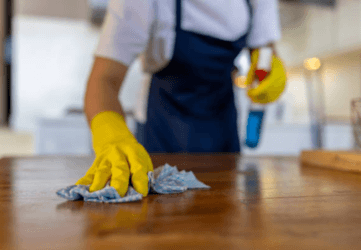
Eco-friendly cleaning has moved from a niche request to a default expectation in Montreal. Whether you're concerned about indoor air quality, have young children or pets in the home, or simply want to reduce chemical exposure, choosing a cleaning service that takes "green" seriously is no longer a luxury — it's table stakes for many Montreal households.
This article explains what eco-friendly cleaning actually means in practice, what to look for in products and practices, what it might cost compared to conventional cleaning, and how Sparkling Stays approaches green cleaning across Greater Montreal.
What "Eco-Friendly Cleaning" Actually Means
"Eco-friendly," "green," and "non-toxic" are loosely used terms. In practice, a genuinely eco-friendly cleaning service is doing four things:
1. Using certified non-toxic products. Look for products certified by recognized organizations: EcoLogo (Canadian government), Green Seal, EWG (Environmental Working Group), or Safer Choice (US EPA). These certifications confirm the products meet specific standards for biodegradability, low toxicity, and reduced VOCs (volatile organic compounds).
2. Avoiding harsh chemicals known to be harmful. This means no bleach (or only sparingly for specific stains), no ammonia, no synthetic fragrances, no chlorine, no quaternary ammonium compounds ("quats"). These chemicals contribute to respiratory issues, skin irritation, and indoor air pollution.
3. Using reusable cleaning tools. Microfibre cloths last hundreds of washes; paper towels last one use. Microfibre is more effective at picking up dirt and reduces both waste and chemical use (because the fibres physically grab dirt without needing chemicals).
4. Minimizing water and packaging waste. Concentrated cleaners reduce packaging; refillable bottles reduce plastic waste; water-efficient practices matter.
A cleaning service that just swaps in "eco" branded products without changing tools, dilution practices, or waste habits isn't really eco-friendly — it's eco-marketed.
Why Montreal Households Choose Eco-Friendly Cleaning
A few drivers consistently come up when our clients tell us why they prefer green cleaning:
Indoor air quality during winter. Montreal winters mean homes are sealed up tight for 5–6 months a year. Conventional cleaning chemicals can build up in indoor air, especially in condos with recirculating HVAC. Switching to low-VOC products noticeably improves how a home "feels" during winter.
Pets that lick floors and counters. Cats and dogs that walk on cleaned floors then groom themselves, or lounge on freshly cleaned countertops, ingest residue. Non-toxic products reduce that exposure.
Children with sensitive skin, asthma, or allergies. Many conventional products contain fragrances and allergens that trigger reactions in sensitive kids.
Asthma sufferers and chemical sensitivities. Adults with respiratory conditions or MCS (multiple chemical sensitivities) often can't tolerate conventional cleaners.
Environmental concern. Cleaning chemicals eventually wash down drains and into the St. Lawrence watershed. Biodegradable formulations break down in days; petrochemical formulations persist much longer.
What Eco-Friendly Products Actually Cost
A common misconception is that eco-friendly cleaning is significantly more expensive. The reality is more nuanced:
- Per-bottle cost of certified eco products is sometimes 15–30% higher than conventional drugstore brands, but professional-grade eco products (what we use) often cost about the same as professional conventional products.
- Microfibre tools have higher upfront cost but lower long-term cost than paper towels and disposable wipes.
- Concentrates and refill systems save money long-term and reduce packaging waste.
- The actual price difference to you as a cleaning customer is usually zero — most professional cleaning companies (including us) include eco-friendly products as the default without surcharge.
If a cleaning service tries to charge you a "green premium" of 20%+ for eco products, that's a flag that they're marketing green rather than practicing it.
What Sparkling Stays Uses
We use a mix of professional-grade eco-certified products plus simple homemade solutions for specific applications:
- All-purpose cleaner: water-based, plant-derived surfactant, fragrance-free or essential oil-based
- Glass cleaner: vinegar + water for streak-free glass (or specific eco glass formulas for tinted/coated glass)
- Bathroom cleaner: hydrogen peroxide-based for mold/mildew, citric acid for limescale
- Floor cleaners: pH-neutral concentrates that won't damage hardwood, engineered wood, or stone
- Kitchen degreaser: enzyme-based or citrus-based
- Wood polish: beeswax-based or olive oil-based natural conditioners
- Tools: HEPA-equipped vacuums, microfibre cloths (washed between every job), separate cloths for kitchens and bathrooms to avoid cross-contamination
We do NOT routinely use bleach, ammonia, synthetic fragrances, or chlorine-based products. If a specific situation requires stronger intervention (e.g., black mold remediation), we discuss it with the client first and use targeted chemicals only where necessary.
When Eco-Friendly Has Limits
Honesty matters. Eco-friendly cleaning has a few limitations worth acknowledging:
Heavy mold or biological hazards sometimes require diluted bleach or commercial fungicides — eco products are limited here. For black mold, contact a remediation specialist.
Construction-grade post-renovation grime sometimes requires solvents to remove adhesive residue, paint splatters, or specialized films. Eco solvents exist (orange oil, citrus terpenes) but work slower.
Hard-water mineral buildup on shower glass takes either acidic treatments (citric acid is fine, eco-friendly) or mechanical scrubbing. There's no "wave a wand" eco solution.
Sticky residue from old labels, tape, or adhesives sometimes needs a small amount of isopropyl alcohol or eco-friendly citrus solvent.
A realistic eco-friendly service uses non-toxic methods 95%+ of the time but doesn't promise miracles in the remaining edge cases.
Pet-Safe and Kid-Safe Cleaning
For households with pets and young children, eco-friendly often overlaps with "safe to touch and breathe." Specific considerations:
- Pet-safe floor cleaners: water-based, no essential oils that are toxic to cats (tea tree, peppermint, citrus oils in concentrated form can be problematic for cats specifically)
- Counter cleaners: rinse-free formulations or rinse with water after, so residue doesn't transfer to food prep surfaces
- Bath cleaners: rinse thoroughly to remove any acidic or alkaline residue before pets or kids use the area
- Air time: open windows during and after cleaning when possible; some natural products (vinegar) still have strong scents even though they're non-toxic
For pet-safe deep cleaning, mention pets at booking so the cleaning team can adjust products and methods.
Booking Eco-Friendly Cleaning with Sparkling Stays
Eco-friendly is our default — you don't need to request it. If you have specific products you'd prefer us to use, or specific products to avoid, mention them at booking. We've worked with clients managing:
- Severe chemical sensitivities (fragrance-free, dye-free everything)
- Cat-specific requirements (no essential oils)
- Newborn-in-home protocols (mild, water-based, no residue)
- Eczema and severe allergy households (hypoallergenic certified only)
[Book online](/en/book-now) or call 438-223-2011. For households with specific sensitivities, we offer a brief phone consultation before the first visit to align products and protocols.
Eco-Friendly Cleaning for Montreal's Main Housing Types
Montreal's housing stock is unusually diverse — and eco-friendly cleaning has different technical considerations depending on your home type.
Pre-war triplexes and duplexes (1890s–1940s) Most of these have original hardwood floors finished with oil or wax rather than polyurethane. Steam mops and alkaline cleaners can raise the grain and cause warping. Our eco approach: pH-neutral hardwood cleaner on a barely-damp microfibre mop, and natural beeswax conditioning where the floor is showing wear. Cast-iron radiators collect dust quickly — we wipe them down with dry microfibre to avoid dispersing particles into the air. Plaster ceilings are delicate; we use soft-bristle tools only.
Condos and high-rises (1980s–present) Modern condos with fan coil HVAC recirculate indoor air constantly, which concentrates cleaning VOCs faster than naturally ventilated homes. In condos, we prioritize fragrance-free, low-VOC products and crack a window during the visit when building policy allows. Polished concrete, engineered hardwood, and quartz countertops all require pH-neutral cleaners — which align perfectly with our standard eco toolkit.
Suburban single-family homes (1950s–1980s) Forced-air heating systems distribute fine particulate throughout the home via vents and ducts. HEPA-equipped vacuums and microfibre cloths trap these particles instead of redistributing them the way feather dusters do. Older ceramic tile bathrooms often have grout that responds well to citric acid-based cleaners (no bleach needed for routine maintenance). Finished basements accumulate off-gassing from aging materials — eco products with no added chemical burden are the right choice here.
Across all Montreal housing types, eco-friendly products tend to be gentler on the specific surfaces found in older housing stock — making them the technically correct choice, not just the ethical one. For more detail on housing-specific cleaning in your neighbourhood, see our guides to [NDG](/en/blog/cleaning-services-ndg-montreal-guide), [Plateau Mont-Royal](/en/blog/cleaning-services-plateau-mont-royal-montreal-guide), [Griffintown condos](/en/blog/cleaning-services-griffintown-montreal-guide), and [Ahuntsic bungalows](/en/blog/cleaning-services-ahuntsic-cartierville-montreal-guide).
Frequently Asked Questions
Is eco-friendly cleaning as effective as conventional? For 95%+ of cleaning tasks, yes. The myth that "green doesn't work" comes from low-quality consumer products. Professional-grade eco cleaners (which we use) work as well as conventional, and the techniques (microfibre, contact time, mechanical action) matter more than chemical strength.
Will my home smell "weird" after eco cleaning? Some eco products use essential oils (lavender, lemon, eucalyptus). If you prefer no scent at all, we use fragrance-free formulations on request. Vinegar-based products have a brief vinegar smell that dissipates in 15–30 minutes.
Do I need to provide products if I want eco cleaning? No. We bring everything. If you have specific products you want us to use, we'll happily use yours instead.
Are eco products safe for kitchen counters where I prepare food? Yes. We use food-contact-safe products on kitchen surfaces (or rinse thoroughly after cleaning).
What about disinfection? Don't I need bleach? Hydrogen peroxide (3% solution) is effective at killing most bacteria and viruses, including SARS-CoV-2, when allowed proper contact time (1–5 minutes). It's gentler than bleach and breaks down to water and oxygen. We use it routinely.
How do I know if a cleaning product is actually eco-certified in Canada? Look for the EcoLogo mark (also known as the Environmental Choice Program — a federal government certification confirming biodegradability, low aquatic toxicity, and VOC content limits). Green Seal is a comparable US standard widely recognized in Canada. ECOCERT certifies organic-standard products for food-contact surfaces. Consumer labels like "natural," "plant-based," or "eco" have no regulatory backing and can appear on almost any product. If you want to verify a specific product, the EcoLogo certified product database is publicly searchable at environmentalchoice.com.
Eco-friendly cleaning is about choosing methods and products that work just as well without unnecessary chemical exposure. For most Montreal households, it's the obviously better choice.


