
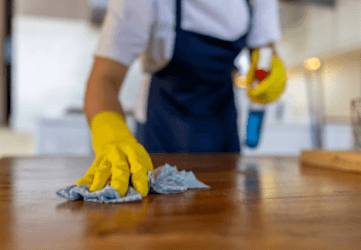

Stainless steel looks stunning the first week you move in — and then Montreal gets to work on it. The city's tap water carries 90–150 mg/L of calcium carbonate (CaCO₃) from the St. Lawrence watershed, among the highest hard-water concentrations in eastern Canada. Within two to four days of normal use, white mineral scale begins forming on fridge handles, dishwasher panels, and oven door trim. Add the greasy film from everyday cooking and the result is a kitchen that looks perpetually dull no matter how often you wipe it.
This guide covers every stainless steel surface in a typical Montreal home — fridge, dishwasher, oven, microwave, range hood, and small countertop appliances — with the correct technique, the right products, and the specific mistakes that turn a quick wipe into a permanent surface scratch.
*Looking to clean your stainless steel kitchen sink? See our companion guide: [How to Clean a Stainless Steel Sink in Montreal](/blog/how-to-clean-a-stainless-steel-sink-montreal).*
Why Montreal's Hard Water Makes Stainless Steel So Much Harder to Clean
Montreal draws its water supply from the St. Lawrence River and processes it through filtration and chlorination, but dissolved minerals — primarily calcium and magnesium bicarbonates — pass straight through and emerge from every tap. At 90–150 mg/L CaCO₃, the water sits in the "hard" to "very hard" range. When it evaporates off a stainless steel surface it leaves behind a white or off-white residue that bonds to the chromium-oxide passivation layer on the steel's surface.
The passivation layer is what makes stainless steel stainless — it is a microscopically thin self-repairing film of chromium oxide that prevents rust. Harsh cleaning products, abrasive pads, and circular scrubbing motions all damage this layer, leaving the steel vulnerable to rust and permanent etching. The calcium scale problem on top of the passivation-layer sensitivity means Montrealers need to be precise: you are removing calcium without stripping the protective oxide.
The One Rule You Must Follow: Go With the Grain
Every piece of brushed stainless steel has a grain — a direction of parallel micro-scratches left by the manufacturing brushing process. Look at your fridge door in raking light and you will see them clearly, usually running horizontally or vertically.
Always wipe parallel to the grain. Never use circular motions.
Circular wiping or scrubbing crosses the grain and creates new cross-hatch micro-scratches that are permanent. They fill with grease and grime much faster than grain-aligned scratches and create a dull, hazy appearance that no amount of polishing will fix. Every professional cleaning team knows this rule; most DIY wipe-downs ignore it.
What Never to Use on Stainless Steel
Bleach or Javex — chlorine bleach is the worst thing you can apply to stainless steel. Chloride ions attack the passivation layer, causing pitting corrosion that is impossible to repair without professional polishing. Montreal tap water already contains residual chlorine; adding more accelerates damage.
Steel wool or Scotch-Brite green pads — both create deep cross-grain scratches immediately.
Window cleaner (Windex) or ammonia-based sprays — leave a blue-tinted streaky film; ammonia also degrades the passivation layer with repeated use.
Dish soap with heavy degreasers — fine for light cleaning but leaves a residue that dulls the finish if not rinsed completely.
Paper towels — the wood fibres in paper towels are abrasive enough to leave micro-scratches. Use a microfibre cloth exclusively.
The Right Products for Montreal Stainless Steel
White vinegar (5% acetic acid) — dissolves calcium carbonate scale quickly. Use diluted 1:1 with water for most surfaces; full-strength for stubborn mineral rings. Never leave vinegar on stainless for more than 10 minutes; rinse well afterward.
Mineral oil or baby oil — applied after cleaning, creates a thin barrier that slows new calcium and grease adhesion. A few drops on a microfibre cloth, wiped with the grain, leaves a subtle protective shine. Repeat monthly.
Bar Keepers Friend (powder or liquid) — contains oxalic acid which is excellent for rust spots and stubborn mineral stains. Wet the surface, apply, rub gently *with the grain* for 30–60 seconds, then rinse immediately. Do not leave it sitting on the steel.
Weiman Stainless Steel Cleaner & Polish — widely available at IGA, Maxi, and Canadian Tire in Montreal. Combines cleaner and protective coating in one step. Good for maintenance once the surface is already scale-free.
Distilled water for rinsing — optional but ideal: rinsing with hard tap water re-deposits calcium immediately. For a deep clean, a final wipe with distilled water prevents instant re-spotting.
How to Clean Each Stainless Steel Appliance
Refrigerator Exterior and Handles
1. Spray a 1:1 vinegar-water solution onto a microfibre cloth (not directly on the fridge — avoid over-spray on door seals and gaskets). 2. Wipe with the grain from top to bottom or left to right — check the direction on your specific fridge. 3. For calcium rings around the water dispenser or ice maker, apply undiluted vinegar, wait 5 minutes, then wipe with the grain. 4. Dry immediately with a clean microfibre cloth. 5. Apply 3–4 drops of mineral oil on a fresh cloth and buff with the grain for lasting protection. 6. Handles need re-cleaning at least weekly: they collect the most grease and are touched multiple times daily.
*See our full [deep-clean fridge guide](/blog/how-to-deep-clean-a-fridge-montreal) for interior cleaning including shelves, drawers, and condenser coil vacuuming.*
Dishwasher Front Panel
Dishwasher panels sit low and catch splash-back from the kitchen floor and from the door opening. The fingerprints and water spots here are among the most visible surfaces in any kitchen.
1. Wipe with a damp microfibre cloth first to remove loose debris. 2. Apply vinegar solution on a cloth and wipe with the grain. 3. For the control panel area at the top, use a barely-damp cloth — avoid excess moisture near electronics. 4. Dry and buff with mineral oil.
*Read our [dishwasher cleaning guide](/blog/how-to-clean-a-dishwasher-montreal) for the interior drum, spray arms, and filter maintenance.*
Oven Door Trim
The stainless trim around the oven door glass is exposed to splattered grease baked at high temperature. Baked-on grease requires more than vinegar.
1. Let the oven cool completely before touching the trim. 2. Apply a small amount of Bar Keepers Friend liquid to the trim, working with the grain. 3. Wait 30 seconds, then wipe with a damp microfibre cloth, still following the grain. 4. Follow with a vinegar treatment for any remaining calcium spots. 5. Dry and buff with mineral oil.
*For cleaning the interior of the oven, see our [oven deep-clean guide](/blog/how-to-deep-clean-an-oven-montreal).*
Microwave Exterior
The microwave handle and door frame collect as much grease as the oven trim, plus fingerprints from multiple daily uses.
1. Apply vinegar-water solution to a microfibre cloth, wipe with the grain. 2. If the handle has crusted grease, apply a small amount of Bar Keepers Friend and rub gently with the grain. 3. Rinse, dry, and buff with mineral oil.
*Our [microwave cleaning guide](/blog/how-to-clean-a-microwave-montreal) covers interior steam-clean methods.*
Range Hood Body and Filter Housing
The range hood body is the surface most exposed to cooking grease vapour. Without regular cleaning, grease builds up as a sticky amber film that traps airborne dust and becomes progressively harder to remove.
1. Spray vinegar solution onto a cloth and wipe with the grain from top to bottom. 2. For light grease, this is usually enough — wipe, dry, done. 3. For sticky amber grease buildup, mix 50/50 dish soap and white vinegar on a warm cloth and wipe with the grain. Rinse with a clean damp cloth. 4. Bar Keepers Friend for any stubborn cooked-on deposits. 5. Dry immediately — range hoods are exposed to steam and need to stay dry to avoid rust forming behind the filter housing.
*Read our detailed [range hood cleaning guide](/blog/how-to-clean-a-range-hood-montreal) for filter degreasing and motor fan maintenance.*
Small Countertop Appliances (Toaster, Kettle Exterior, Stand Mixer Body)
Small stainless appliances follow the same grain rule but are often overlooked because they're compact. The toaster shell and the exterior of a KitchenAid stand mixer are the most commonly neglected stainless surfaces in Montreal kitchens.
1. Unplug before cleaning. 2. Vinegar-water solution on a microfibre cloth, wipe with the grain. 3. Dry thoroughly — water sitting near heating elements or motor vents is a hazard. 4. Monthly mineral oil buff on any brushed stainless exterior.
Monthly Maintenance Schedule
| Frequency | Task | |-----------|------| | After each use | Wipe handles and water-dispenser drips with a dry microfibre cloth | | Weekly | Full wipe-down with vinegar-water + dry buff on all visible stainless surfaces | | Monthly | Mineral oil treatment on all stainless surfaces; Bar Keepers Friend on any rust specks | | Seasonally | Deep-clean range hood body; check fridge condenser coils |
Where to Buy Stainless Steel Cleaning Products in Montreal
| Product | Where to Buy | Approximate Price | |---------|-------------|-----------------| | Bar Keepers Friend powder (340 g) | Canadian Tire, IGA, Maxi, Jean Coutu | $6–$9 | | Weiman Stainless Steel Cleaner | Canadian Tire, Walmart, Home Depot | $9–$12 | | White vinegar (4 L) | Any grocery store, Costco | $3–$6 | | Mineral oil (food-grade) | Pharmaprix, Jean Coutu, Walmart | $5–$8 | | Microfibre cloths (pack) | Dollarama, Canadian Tire | $3–$8 |
For a complete kitchen deep-clean that covers all stainless steel surfaces plus appliance interiors and countertops, see our [kitchen deep-clean guide](/blog/how-to-deep-clean-a-kitchen-montreal). We also carry guidance on [eco-friendly cleaning products](/blog/eco-friendly-cleaning-montreal) that are safe for stainless steel passivation layers.
---
FAQ — Stainless Steel Appliance Cleaning in Montreal
Q: How do I remove white water spots from my stainless steel fridge?
A: White spots on stainless steel are almost always calcium carbonate scale from Montreal's hard water (90–150 mg/L CaCO₃). Apply undiluted white vinegar to a microfibre cloth and wipe with the grain of the steel. For stubborn spots, hold a vinegar-soaked cloth against the spot for 5 minutes before wiping. Rinse with a clean damp cloth and dry immediately. Follow with a mineral oil buff to slow re-spotting. Never use bleach or Windex — both damage the passivation layer that protects the steel from rust.
Q: Can I use Windex or glass cleaner on stainless steel appliances?
A: No. Glass cleaners contain ammonia which leaves a streaky film on stainless steel and degrades the protective chromium-oxide passivation layer with repeated use. The ammonia reacts with the iron in the steel alloy and can cause surface discoloration over time. Use white vinegar solution instead — it cleans more effectively, leaves no film, and is safe for the passivation layer when rinsed within 10 minutes.
Q: My dishwasher front panel has rust spots. Is it ruined?
A: Small rust spots on stainless steel appliances are almost always surface rust, not structural corrosion — and Bar Keepers Friend removes them without damaging the underlying steel. Wet the spot, apply a small amount of Bar Keepers Friend powder or liquid, rub gently *with the grain* for 30–45 seconds, then rinse completely. Dry and buff with mineral oil. If the rust returns within days, there may be a deep scratch exposing bare iron; at that point, professional polishing or a stainless steel touch-up kit is the next step.
Q: What is the "grain" on stainless steel and how do I find it?
A: The grain on brushed stainless steel is the direction of the fine parallel scratches left by the manufacturing brushing process. To find it, look at the surface in strong raking light — angle a flashlight or your phone's flashlight sharply across the surface. You will see a pattern of parallel lines running either horizontally or vertically. Always wipe in the same direction as these lines. Wiping across or in circles creates permanent cross-hatch scratches that dull the finish and trap grease faster than grain-aligned marks.
Q: How often should I apply mineral oil to stainless steel appliances?
A: In Montreal, once a month is the right cadence for most households. Mineral oil creates a thin hydrophobic barrier that slows calcium scale adhesion and makes weekly wipe-downs faster and easier. Apply 3–4 drops to a clean microfibre cloth and buff with the grain until the surface looks uniformly shiny with no excess oil. Use food-grade mineral oil — available at most pharmacies — on any surface that might contact food, particularly around the fridge water dispenser. On the range hood body, apply sparingly since excess oil can collect cooking grease vapour.
Q: Is it safe to use vinegar on all stainless steel appliances?
A: White vinegar (5% acetic acid) is safe for stainless steel when used correctly: diluted 1:1 with water for regular cleaning, full-strength for calcium spots, and always rinsed off within 10 minutes. Do not let vinegar pool in seams or around rivets, and avoid prolonged contact with door gaskets (the rubber degrades). Apply with a cloth rather than spraying directly to avoid overspray on electronics. For an eco-friendlier alternative, citric acid powder dissolved in water works the same way as vinegar and is even gentler on the steel. See our [eco-friendly cleaning guide](/blog/eco-friendly-cleaning-montreal) for more Montreal-safe options.
---
Keeping stainless steel appliances looking their best in Montreal is a weekly commitment, not a once-a-year project. With the grain-direction rule, a weekly vinegar wipe, and a monthly mineral oil buff, most Montreal kitchens can maintain showroom-quality stainless steel without professional help.
When the build-up is already severe — baked-on grease on the range hood, heavy calcium scale on the fridge, or rust spots from long neglect — our team handles it as part of a full [kitchen deep clean](/services/deep-cleaning). [Book online](/book-now) or explore our [home cleaning services](/services/home-cleaning) for regular maintenance that keeps every surface in your Montreal home in top condition.

