
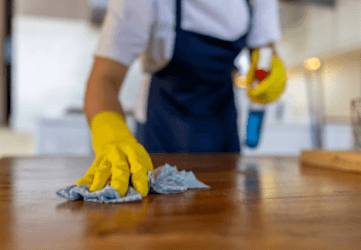
 *Photo: Unsplash*
Streaky windows are one of the most common frustrations in Montreal apartments. You spray, you wipe, you step back — and the light catches a haze of white streaks and cloudy patches. In most cases, the culprit is not your technique or your cleaner. It's Montreal's hard water, which leaves a thin film of calcium carbonate on glass every time it evaporates. Understanding that distinction changes everything about how to clean windows correctly.
This guide covers how to clean window glass without streaks in Montreal — interior panes, how to handle the city's unique challenges (hard water, cottonwood pollen, road salt spray, and tinted condo windows), and what to avoid that makes streaking worse.
---
Why Montreal Windows Streak: It's Calcium, Not Soap
In most of Canada, window streaks are caused by soap residue or cleaning solution applied too liberally. In Montreal, the primary cause is different: calcium carbonate.
Montreal's municipal water comes from the St. Lawrence River and is treated to a hardness of 90–150 mg/L calcium carbonate — among the highest of any major Canadian city. Every time water (rain, condensation, or mop splash) evaporates on glass, it leaves behind dissolved calcium as a thin white mineral film. Over several rain events or weeks of interior condensation, these films stack up into a visible haze.
This haze has a key property: it does not respond to soap. Standard glass cleaners with soap remove grease and grime but do not dissolve calcium carbonate. White vinegar (dilute acetic acid) does — it reacts with CaCO₃ and converts it to calcium acetate, which wipes away cleanly.
This is why Montreal windows that look clean after wiping still show streaks in direct sunlight: the cleaning removed surface dirt but left the calcium mineral film behind.
---
Montreal-Specific Window Cleaning Challenges
1. Hard Water Calcium Haze (90–150 mg/L CaCO₃)
The most significant challenge. Calcium deposits build up on both exterior and interior glass:
- Exterior glass: Every rain event deposits calcium as the water evaporates. In summer, one rainstorm per week can deposit enough calcium to create visible haze within 2–3 weeks.
- Interior glass: Pre-war triplex windows (single-pane, NDG/Plateau/Rosemont/HoMa/Villeray) accumulate interior condensation November through March. That condensation carries minerals from the indoor air — cooking steam, humidifier mist, hard tap water splatter near the kitchen window.
Treatment: White vinegar is the first-line solution. A solution of 50–100 mL white vinegar per 500 mL of water dissolves calcium on contact. For stubborn haze built up over many months, use undiluted white vinegar applied on a microfibre cloth with a 3–5 minute dwell before buffing off.
2. Cottonwood Pollen Film (May–June)
Every May through mid-June, peuplier du Canada (trembling aspen and cottonwood poplar) releases white fibres that accumulate on window glass. The fibres carry a yellow-green sticky pollen that coats glass with a thin organic film. This film is different from calcium: it's sticky and organic, not mineral.
Cottonwood protocol: - Dry wipe the glass first with a dry microfibre cloth to remove fibres and pollen before any wet cleaning. If you spray cleaning solution onto glass covered in cottonwood pollen, the pollen smears into a streaky yellow-orange film that's much harder to remove. - Follow with your normal wet cleaning protocol.
3. Road Salt Spray (October–April)
Ground-floor and garden-level windows accumulate calcium chloride (CaCl₂) salt spray from traffic and pedestrians from October through April. This appears as white crystalline deposits on the lower 30–60 cm of exterior window panes. CaCl₂ is water-soluble and dissolves easily with a vinegar solution — but must be removed before it absorbs ambient humidity and redeposits.
4. Tinted and Solar-Film Windows in DCC Condos
Post-2010 condos in Griffintown, Verdun, Plateau, and Mile-Ex commonly have factory-tinted glass or aftermarket solar film applied to interior glass surfaces. Ammonia — present in standard Windex and many glass cleaners — permanently damages tinting films and solar films. The ammonia breaks down the film's bonding adhesive, causing it to haze, bubble, or peel.
If your windows have a tint or film: - Use only ammonia-free glass cleaners: Eco-Max Glass Cleaner (Jean Coutu/Rachelle-Béry/IGA), Method Glass + Surface (IGA/Jean Coutu), or your own white vinegar solution. - If uncertain whether your condo windows have solar film, check the window edge — factory tinting is embedded in the glass; solar film has a slightly soft edge when you run your fingernail along the frame-glass join.
5. Pre-War Single-Pane Wood Frame Windows
Many NDG, Plateau-Mont-Royal, Rosemont, HoMa, and Villeray triplexes still have original 1900s–1950s wooden-frame single-pane windows. These frames were often painted with lead-based paint (pre-1960) or oil-finish alkyd paint, and may have original linseed oil glazing putty in the frame.
Wood frame rule: Clean the glass only — keep all cleaning solution off the wood frame. White vinegar, even diluted, can damage old linseed oil putty and soften alkyd paint over repeated use. Use a damp microfibre cloth for the frame with plain warm water only, or a pH-neutral all-purpose cleaner.
---
What NOT to Use on Windows
| Product/Method | Why It Causes Streaks or Damage | |---|---| | Standard Windex (with ammonia) | Effective on clean glass, but damages solar/tinting films; ammonia in a humid bathroom or kitchen can leave residue | | Dish soap directly on glass | Creates a calcium-soap compound when combined with Montreal hard water; leaves a scum film that becomes the new streak layer | | Paper towel | Leaves fine lint fibres that become trapped under the calcium film and show as white flecks in direct sunlight | | Circular motions | Spreads calcium in a circular pattern that concentrates in the wipe arc; creates the classic circular streaks | | Newspaper alone (dry) | Newspaper alone smears grime; it works for buffing after wet cleaning, but not as the primary wipe | | CLR or lime removers directly on glass | Too aggressive for glass sealant and frame materials; use only white vinegar or citric acid |
---
The Correct Method: Two-Cloth Protocol
The two-cloth method is the most streak-free approach for interior glass in Montreal apartments:
What you need: - Two clean microfibre cloths (one for wet, one for dry) - Spray bottle with your cleaning solution - Optional squeegee for exterior-facing panes
Cleaning solution options: 1. DIY vinegar solution (best for calcium): 50 mL white vinegar + 500 mL warm water + 1 drop dish soap. The dish soap helps break surface tension; the vinegar dissolves calcium; the water dilutes to prevent residue. 2. Commercial ammonia-free: Eco-Max Glass Cleaner, Method Glass + Surface, or Seventh Generation Glass Cleaner — all safe for tinted glass. 3. Stubborn calcium (undiluted): Pure 5% white vinegar applied on a cloth with 3–5 minute dwell. For very stubborn mineral scale.
Steps: 1. Dry wipe first (especially during cottonwood season May–June, and during road salt season October–April). Use a dry microfibre cloth to remove pollen, dust, and loose mineral particles. This prevents dragging grit across the glass. 2. Spray the cleaning solution onto the glass, not onto the cloth. Apply enough to cover the pane in a light mist — do not saturate. 3. Wipe with the first (damp) microfibre cloth using a Z-pattern or S-pattern: horizontal stripes, top to bottom, slightly overlapping. Do not use circular motions. 4. Immediately buff with the second dry microfibre cloth before the solution dries. Work the same Z-pattern. The dry cloth absorbs the solution and any calcium it dissolved before it can re-deposit.
The speed of step 4 matters: in Montreal summer heat, the cleaning solution evaporates in 30–60 seconds on a warm pane. In direct sunlight, even faster. Work one pane at a time, not all windows at once.
---
Squeegee Method (Exterior and Larger Panes)
For exterior glass accessed by leaning through the window (common in Montreal second-floor apartments), a squeegee is faster and more effective than the two-cloth method:
1. Soak the glass with your cleaning solution or a sponge wet with vinegar solution. 2. Pull the squeegee from top to bottom in a single stroke, angled slightly so water runs to one side. 3. Wipe the squeegee blade after each pass. 4. Buff the edges and any drip lines with a dry microfibre cloth.
Squeegee models: IKEA (~$3–4, adequate for one-season use), Ettore or Unger professional squeegees (Canadian Tire/Home Depot ~$12–20, longer-lasting with replaceable rubber blades).
---
Removing Heavy Calcium Haze (Build-Up From Years of Neglect)
If the glass has not been properly cleaned for years and has a thick white mineral layer that a standard vinegar solution doesn't cut through:
Method 1: Undiluted white vinegar dwell - Saturate a microfibre cloth with undiluted 5% white vinegar. - Press the cloth against the glass for 3–5 minutes — do not let it dry on the glass. - Rub in a Z-pattern. - Buff dry immediately. - Repeat 2–3 times if needed.
Method 2: Citric acid paste - Mix 1 tablespoon citric acid powder with enough water to form a thin paste. - Apply to glass with a microfibre cloth. - Leave for 5 minutes. - Buff off with a damp cloth, then dry immediately. - Citric acid (Bulk Barn ~$5–8/500 g; IGA Natural) is stronger than vinegar for thick calcium scale.
---
Montreal Product Sourcing
| Product | Where to Buy | Price | |---|---|---| | White vinegar 4L | IGA, Maxi, Metro, Dollarama | ~$3–5 | | Eco-Max Glass Cleaner (ammonia-free, Quebec-made) | Jean Coutu, Rachelle-Béry, IGA | ~$5–7 | | Method Glass + Surface (ammonia-free) | IGA, Jean Coutu, Maxi | ~$5–7 | | Windex (contains ammonia — NOT for tinted glass) | Maxi, IGA, Dollarama, Pharmaprix | ~$4–6 | | Microfibre cloths (6-pack) | Canadian Tire, Costco, Dollarama | ~$5–15 | | Squeegee | IKEA (~$3), Canadian Tire (~$6–8), Home Depot (~$12–20) | ~$3–20 | | Spray bottle (250–500 mL) | Dollarama, Canadian Tire | ~$2–3 | | Citric acid powder (500 g) | Bulk Barn, IGA Natural, Jean Coutu | ~$5–8 |
---
Frequently Asked Questions
Q: Why do my windows still streak after cleaning?
A: In Montreal, window streaks are almost always caused by calcium carbonate — not soap or technique. Montreal tap water hardness is 90–150 mg/L CaCO₃; every rain event and interior condensation episode deposits this calcium on the glass. Standard glass cleaners remove grime but do not dissolve calcium. Switch to a white vinegar-based solution (50 mL vinegar + 500 mL water) and use a dry microfibre cloth immediately after the wet wipe, before the solution dries and re-deposits calcium. Also ensure you dry-wipe before any wet cleaning to remove loose mineral particles that would otherwise spread as streaks under a wet cloth.
Q: Can I use Windex on my Montreal condo windows?
A: Only if your windows are standard clear glass with no tinting or solar film. Many post-2010 condos in Griffintown, Plateau, Verdun, and Mile-Ex have aftermarket solar film or factory-tinted glass applied to interior surfaces. Windex contains ammonia, which permanently damages these films — causing hazing, bubbling, or peeling. Check with your building management if unsure. For any window with a tint or film, use an ammonia-free alternative: Eco-Max Glass Cleaner, Method Glass + Surface, or DIY white vinegar solution.
Q: What is the best homemade window cleaner for Montreal's hard water?
A: The most effective DIY solution for Montreal's hard water is: 50 mL white vinegar + 500 mL warm water + 1 drop of dish soap. The white vinegar (acetic acid) dissolves calcium carbonate on contact; the dish soap breaks surface tension for better coverage; the water dilutes the acid so it doesn't leave residue. For glass with heavy built-up calcium scale, use undiluted white vinegar applied with a cloth and left to dwell for 3–5 minutes before buffing off.
Q: How do I remove hard water stains from windows in Montreal?
A: For light calcium haze (2–4 weeks of buildup): diluted white vinegar solution (50 mL/500 mL water) with a two-cloth method. For moderate buildup (1–3 months): undiluted 5% white vinegar, 3–5 minute dwell, buff off, repeat as needed. For heavy buildup (years of neglect): citric acid paste (1 tbsp citric acid powder + 1 tsp water), 5-minute dwell, buff off with a damp cloth. Never use CLR, Lime-A-Way, or abrasive scrubbers directly on glass — they can etch the surface.
Q: Why do my windows get foggy and streaky in winter in my Montreal apartment?
A: Pre-war triplex windows (single-pane, without thermal break) condensate heavily November through March when the cold exterior glass meets warm humid interior air. The condensation deposits minerals from the indoor air — cooking steam, humidifier mist — as thin mineral layers that build up over the winter. This is normal in NDG, Plateau, Rosemont, and HoMa pre-war apartments. Clean with white vinegar solution monthly during the heating season (October–April) to prevent mineral layer accumulation. If condensation is extreme (water running down the glass), the windows may need weatherstripping; a landlord habitability complaint may be warranted under Quebec Civil Code if the building's windows are failing.
Q: How often should windows be cleaned in a Montreal apartment?
A: For interior glass: monthly during the heating season (October–April) when condensation deposits minerals, and after the cottonwood season ends (mid-June) when a pollen film accumulates. For exterior glass accessible from inside: spring (May, after cottonwood) and autumn (September, before road salt season begins). High-traffic entry windows or kitchen windows near the stove: monthly year-round. As a practical minimum, twice per year (May and October) catches the two key seasonal deposit events.
---
*For other window cleaning guides, see our [window track cleaning guide](/en/blog/how-to-clean-window-tracks-montreal) and [window screen cleaning guide](/en/blog/how-to-clean-window-screens-montreal). For streak-free bathroom mirrors, the same technique applies — see our [bathroom mirror cleaning guide](/en/blog/how-to-clean-bathroom-mirror-and-vanity-montreal). Ready to let a professional handle the full clean? Our [home cleaning service](/en/services/home-cleaning) and [deep cleaning service](/en/services/deep-cleaning) cover all Montreal boroughs.*

