

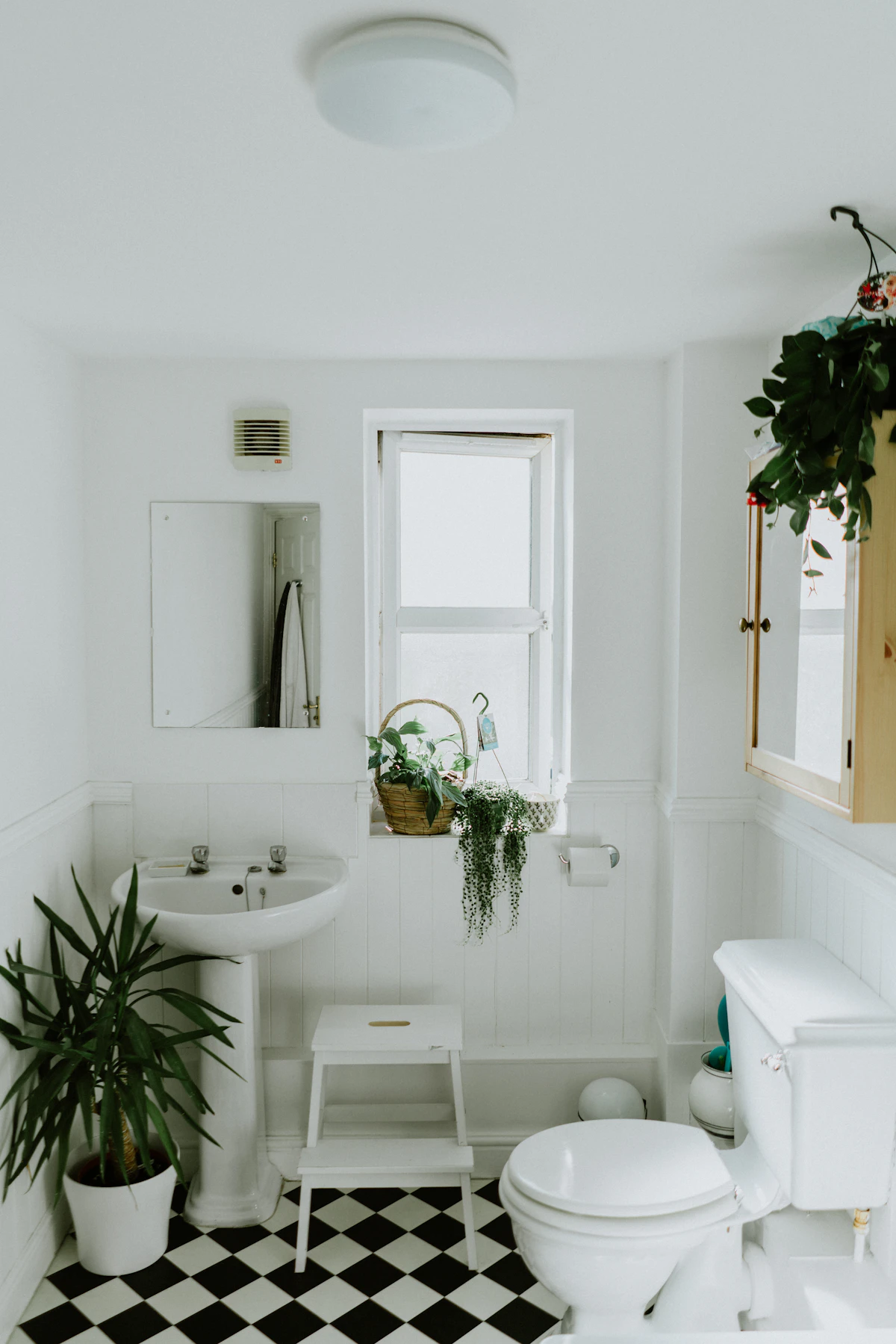
 *Photo: Unsplash*
Bathroom humidity is the leading cause of mould in Montreal apartments. A single five-minute shower can push relative humidity in a small bathroom from 50% to over 90% — and without adequate ventilation, that moisture lingers on ceiling tiles, grout joints, and painted walls for hours, feeding the Cladosporium and Aspergillus colonies that make the average Montreal triplex bathroom a seasonal mould battleground.
This guide covers every practical strategy for reducing bathroom humidity in a Montreal context: from the 15-second daily habit that outperforms most mechanical solutions, to fan CFM sizing for Quebec's notoriously humid summers, to the TAL written-notice protocol when your landlord refuses to install a working exhaust fan.
---
Why Montreal Bathrooms Get So Humid
Montreal's climate creates a uniquely challenging humidity environment:
- Summer baseline RH is already high — July and August average 70–75% relative humidity outdoors. When warm, humid outside air enters through a window, it adds to — not subtracts from — bathroom moisture in summer.
- Pre-war construction lacks mechanical ventilation — NDG, Plateau-Mont-Royal, Rosemont, Hochelaga-Maisonneuve, and Villeray triplexes built between 1890 and 1950 were designed with gravity ventilation through the chimney mass. Most were never retrofitted with electric exhaust fans. Quebec's building code (NBC Art. 9.32) requires mechanical bathroom ventilation in new construction and major renovations, but existing buildings are grandfathered.
- Winter cold surfaces amplify condensation — from November through March, bathroom walls and windows in underheated pre-war buildings can drop to 12–15°C. Shower steam hitting these surfaces condenses instantly, creating a standing water film on tile, paint, and ceiling plaster.
- Tight building envelopes in post-2000 condos — newer Griffintown, Square-Victoria, and Mile-Ex condos are so well-sealed that indoor humidity can spike in summer without adequate HVAC dehumidification.
---
1. The 15-Second Squeegee Habit
The single most effective humidity reduction technique costs $3–6 and takes 15 seconds per shower.
After every shower, before stepping out of the stall:
1. Run a silicone-blade squeegee across all tiled walls, starting at the top and working down 2. Squeegee the shower glass door or curtain rail area 3. Wipe the squeegee blade on your towel and hang it on the shower wall
What this actually does: A typical Montreal shower deposits 100–150 mL of water as a thin film on tile and glass surfaces. Left in place, this water evaporates over 20–30 minutes, converting liquid water into vapour that saturates the bathroom air. The squeegee removes approximately 70–80% of this water before evaporation — meaning the bathroom air receives 70–80% less moisture from wall evaporation.
What to buy: IKEA LILLSKÄR squeegee ($3–5) or a small Ettore-style squeegee at Canadian Tire ($6–8). Hang it from a suction hook inside the shower stall so it is always reachable.
This step alone, combined with leaving the bathroom door open after showering, can suppress ceiling mould growth in a no-fan pre-war bathroom during summer months. It is the foundation on which every other humidity reduction strategy builds.
---
2. Exhaust Fan: Sizing and Running Time
If you have an exhaust fan — or are adding one — correct sizing matters as much as the unit itself.
CFM Requirements for Montreal Bathroom Sizes
The HVI (Home Ventilation Institute) standard is 1 CFM per square foot of bathroom area, with a minimum of 50 CFM:
| Bathroom size | Recommended CFM | Recommended fan model | |---|---|---| | 25–35 sq ft (small triplex) | 50 CFM minimum | Broan 679 ($35–50, Canadian Tire) | | 40–55 sq ft (standard apartment) | 50–70 CFM | NuTone 763N ($45–65, Home Depot) | | 60–80 sq ft (larger bathroom) | 80–100 CFM | Panasonic WhisperCeiling FV-08VF2 ($90–120, Home Depot) | | Bathroom with shower and bathtub in humid July–August | Add 20 CFM | — |
For Montreal's summer humidity peak (July–August when baseline RH is 70–75%), add a 20 CFM buffer above the HVI minimum. A fan that adequately handles humidity in March will be marginal in August.
How Long Should You Run the Fan?
Running the fan only during the shower is not sufficient. Moisture continues evaporating from wet surfaces for 15–20 minutes after the shower ends.
Recommended protocol: - During shower: Run fan continuously - After shower: Continue for at least 20 minutes - Ceiling condensation test: If you can still see moisture on the ceiling mirror after 20 minutes, add another 10 minutes
A simple bathroom fan timer switch ($15–25 at Canadian Tire or Home Depot), set to run for 30 minutes post-shower, is the most effective automation. Leviton and Legrand models work with standard single-gang switch boxes found in pre-war triplex wiring.
Fan Maintenance Reminder
A clean fan is a functional fan. A clogged fan grille reduces airflow by 50% or more. Clean the grille quarterly (wipe with a damp cloth) and vacuum the fan housing annually. See our [bathroom exhaust fan cleaning guide](/en/blog/how-to-clean-a-bathroom-exhaust-fan-montreal) for the full protocol.
---
3. Window Ventilation: When It Helps and When It Hurts
Opening the bathroom window after a shower ventilates steam — but not always as effectively as you might expect, and sometimes counterproductively.
When window ventilation helps: - October through May: outdoor air is cooler and drier than post-shower bathroom air; opening the window creates a pressure difference that draws humid air out - During and immediately after showering on dry days (outdoor RH below 60%)
When window ventilation makes things worse: - July and August in Montreal: outdoor RH of 70–75% means outside air adds approximately as much humidity as it removes. A bathroom that takes 15 minutes to dry with the window open on a dry October day may take 40 minutes on a humid August afternoon. - In winter: cold outside air rushes over warm tile and glass surfaces, immediately condensing as liquid water. The surface gets wet again from condensation even as the bathroom air drys. Keep the window closed in winter and rely on the exhaust fan.
The practical rule: Window + fan running simultaneously is always better than either alone, May through September. In November through March, fan only — leave the window closed.
---
4. Portable Dehumidifier: The No-Fan Solution
For bathrooms in pre-war triplexes with no exhaust fan and no window, a portable dehumidifier is the most effective fallback.
What size to buy: A 30-pint (approximately 14 L/day) dehumidifier is sufficient for a bathroom up to 60 sq ft in Montreal's climate. Look for: - Frigidaire FAD301NWD or FAD504DWD (30–50 pint) — widely available at Canadian Tire, Home Depot, and Rona ($150–250) - hOmelabs 1500 sq ft Energy Star dehumidifier (~30 pint, Amazon.ca/Canadian Tire ~$180–220) - Midea MAD20S1WS (20 pint, suitable for small bathrooms under 40 sq ft, ~$150)
Protocol for bathroom use: 1. Run the dehumidifier in the bathroom for 20–30 minutes after every shower 2. Empty the water reservoir daily during summer; less frequently in drier months 3. Clean the filter monthly during high-use periods (see our [dehumidifier cleaning guide](/en/blog/how-to-clean-a-dehumidifier-montreal)) 4. Target indoor bathroom RH of 50–55% — below 60% significantly suppresses Cladosporium and Aspergillus mould growth rates
A dehumidifier placed in the bathroom doorway (drawing from the bathroom and exhausting into the hallway) works equally well for small bathrooms where floor space is limited.
---
5. Daily Habits That Compound
Individual actions add up. The following habits, combined, can keep bathroom humidity below the 60% RH mould growth threshold even during Montreal's humid summer months:
After every shower: - Squeegee the tile walls and shower glass (15 seconds — see Section 1) - Leave the bathroom door open and the fan running for 20+ minutes - Hang towels on a hook or towel bar rather than draping them over the shower curtain rod — a bunched towel takes 4–6 hours to dry fully and keeps releasing moisture into the bathroom air throughout the day
Daily: - Check the exhaust fan grille for visible dust buildup (if grille is dusty, airflow is compromised) - Do not leave a damp bath mat folded in the shower — hang it flat to dry
Weekly: - Wipe down the bathroom ceiling with a dry microfibre cloth (this removes condensation residue before it becomes mineral scale or mould substrate) - Check the grout joints and caulk lines around the tub and shower for darkening — early-stage Cladosporium growth begins as a grey or black discolouration in grout that can be reversed with hydrogen peroxide at this stage but requires [grout cleaning](/en/blog/how-to-clean-bathroom-grout-and-caulk-montreal) intervention
---
6. What If You Have No Exhaust Fan? (The TAL Protocol)
Quebec tenants in pre-war apartments without bathroom exhaust fans have legal recourse if inadequate ventilation leads to recurring mould.
Quebec Civil Code Art. 1854 requires a landlord to provide a dwelling that is habitable — and recurring bathroom mould from inadequate ventilation meets the habitability threshold under TAL jurisprudence, provided the tenant can demonstrate: 1. The building has no functioning exhaust fan 2. The tenant is using the space normally (not running a humidifier in the bathroom or leaving wet laundry hanging for days) 3. The tenant notified the landlord in writing and the landlord failed to act within a reasonable time
Step-by-Step TAL Strategy
Step 1 — Document the absence of ventilation. Take photographs of the bathroom ceiling showing no fan unit, the bathroom wall showing no exhaust grille, and any existing mould (date-stamp or GPS-stamp the photos).
Step 2 — Send a certified letter (lettre recommandée) to your landlord. The letter should state: (a) the bathroom lacks mechanical ventilation; (b) mould has developed on the ceiling/walls as a result; (c) you request installation of an exhaust fan within 30 days under Civil Code Art. 1854. Send by registered mail (Postes Canada) and keep the tracking receipt.
Step 3 — Wait 30 days for a response. If the landlord installs a fan, document that it works correctly.
Step 4 — File a TAL complaint if no action. The TAL (Tribunal administratif du logement) online filing system allows tenants to request a corrective order requiring the landlord to install ventilation and potentially reduce rent for the period the apartment was not fully habitable. Legal aid (aide juridique) is available at no cost for qualifying tenants through the Barreau du Québec.
Meanwhile: Deploy the squeegee habit, open-door protocol, and portable dehumidifier to protect your health while the legal process unfolds. See our guides on [bathroom ceiling mould](/en/blog/how-to-clean-mold-off-ceiling-montreal), [general apartment mould](/en/blog/how-to-get-rid-of-mold-in-a-montreal-apartment), and [bathroom deep cleaning](/en/blog/how-to-deep-clean-a-bathroom-montreal) for interim remediation.
---
Need a Professional Deep Clean?
If mould has already taken hold in your bathroom, a professional [deep cleaning](/en/services/deep-cleaning) or [home cleaning service](/en/services/home-cleaning) can address the surface mould and give you a clean baseline to maintain with the habits above.
---
FAQ
Q: How long does it take for a Montreal bathroom without a fan to develop mould?
A: In July and August — when Montreal's outdoor relative humidity is 70–75% — an unventilated bathroom used by two people for daily showers can show initial Cladosporium mould growth on the ceiling within 2–4 weeks. The grey or black speckling in grout joints and ceiling corners is the first visible sign. In winter, the timeline is longer (6–12 weeks) because cold surfaces dry faster when the heating system is running, but condensation damage to painted plaster ceilings continues over multiple freeze-thaw cycles. Tile and grout joints are most vulnerable year-round due to their textured surface providing adhesion for mould spores.
Q: What CFM exhaust fan do I need for a standard Montreal apartment bathroom?
A: For a typical Montreal apartment bathroom of 40–55 square feet, a 50–70 CFM fan is the minimum. The HVI standard is 1 CFM per square foot, so a 50 sq ft bathroom needs at least 50 CFM. For Montreal's humid summer months (July–August when outdoor RH reaches 70–75%), add a 20 CFM buffer — meaning a 50 sq ft bathroom benefits from a 70 CFM fan. The Panasonic WhisperCeiling FV-08VF2 (80 CFM, ~$90–120 at Home Depot) is commonly recommended by Montreal electricians for pre-war triplex bathroom retrofits because its brushless DC motor is quiet and energy-efficient. A 30-minute fan timer switch ($15–25 at Canadian Tire) ensures the fan runs long enough post-shower without relying on manual shutdown.
Q: Is my Montreal landlord required to install a bathroom exhaust fan?
A: Under Quebec's building code (NBC Art. 9.32), mechanical ventilation is required in bathrooms without operable windows in new construction and major renovations. For existing pre-war buildings, the code's application depends on whether there is an accessible window. However, Quebec Civil Code Art. 1854 requires landlords to provide a habitable dwelling regardless of construction era. If the absence of ventilation causes recurring mould that makes the bathroom unpleasant or unhealthy, a TAL complaint citing habitability (insalubrité) is viable. Send the landlord a certified letter first documenting the problem and requesting a fan installation within 30 days. If no action is taken, a TAL application can result in a corrective repair order and a temporary rent reduction for the habitability deficiency period.
Q: Does opening the bathroom window after a shower actually help reduce humidity?
A: It depends on the season and outdoor humidity level. From October through May, outdoor air in Montreal is cooler and drier than post-shower bathroom air — opening the window draws moist air out and replaces it with drier air, typically reducing bathroom RH to below 60% in 10–15 minutes. In July and August, outdoor relative humidity in Montreal is 70–75%, so the incoming air adds nearly as much moisture as it removes. Window ventilation in summer is better than nothing, but it takes 30–40 minutes to achieve what a 50 CFM exhaust fan achieves in 15–20 minutes. In winter (November through March), opening the window causes condensation on cold tile surfaces — the cold air meeting warm, humid bathroom air drops moisture immediately onto walls and glass, making surfaces wet again. In winter, use the exhaust fan only and keep the window closed.
Q: How much does it cost to install a bathroom exhaust fan in a Montreal apartment?
A: The fan unit itself costs $35–120 at Canadian Tire, Home Depot, or Rona depending on CFM and noise rating (a quieter Panasonic WhisperCeiling model runs $90–120). Installation by a licensed Montreal electrician (Maître Électricien, Quebec Régie du bâtiment licence required) typically costs $200–400 for a standard installation with new ceiling ductwork run to an exterior soffit or roof vent, plus $150–300 for the duct and vent components. In a pre-war triplex where the fan must duct through a masonry wall to the exterior, costs can reach $500–700. In rental situations, this is a landlord expense — tenants should not pay for installation. If the landlord agrees to install a fan, get the agreement in writing and confirm the work will be done by a licensed electrician.
Q: Will a portable dehumidifier fix bathroom humidity in my Montreal apartment?
A: Yes — a 30-pint (14 L/day) portable dehumidifier run for 20–30 minutes after each shower can reduce bathroom RH from the post-shower peak of 85–90% to below 60% within 20–30 minutes, even without an exhaust fan or operable window. This reliably suppresses Cladosporium mould growth, which requires sustained RH above 60% to colonize painted surfaces and grout. The limitation is operational: the dehumidifier must be run consistently after every shower, the water reservoir must be emptied regularly, and the filter must be cleaned monthly during summer. Dehumidifiers consume 200–400 watts, adding approximately $3–6 per month to a Hydro-Québec bill at typical Montreal rates — a reasonable cost for mould prevention in a no-fan bathroom.

